 KidCasts
 Shared for you
LISTEN TO THIS EPISODE
Dinosaur chicken nuggets with Jingmai O’Connor
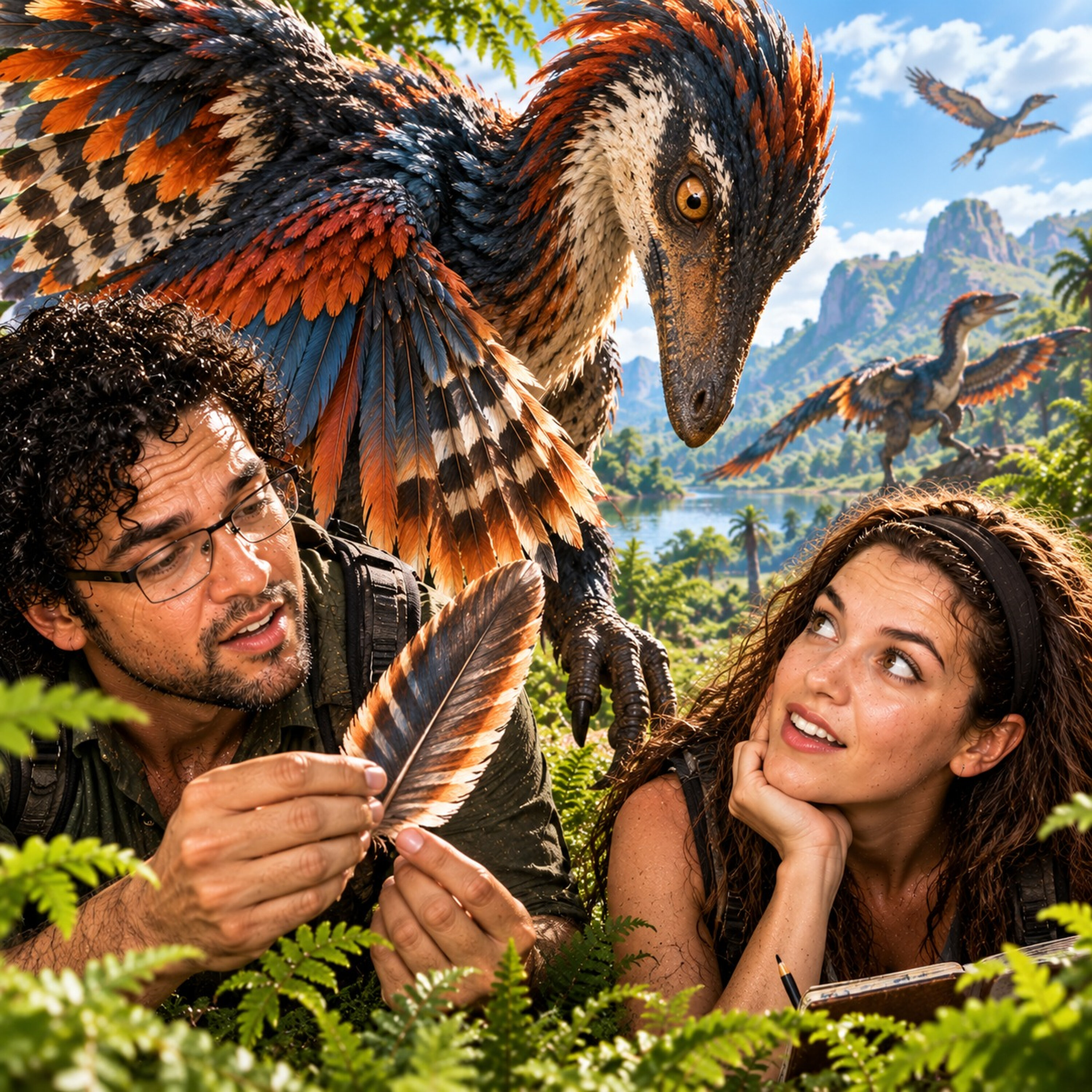
Loads of dinosaurs had wings, but not many of them could fly. There’s a dinosaur in your garden right now, probably the one that keeps stealing your chips, because a seagull is a dinosaur, and so is every robin, pigeon and chicken. Feathers turn up again and again across the dinosaur family tree, and most of them had nothing to do with flying. Oviraptors spread their feathered arms over their nests to keep their eggs warm, and some parents have been found still sitting on them. Others used feathers for showing off and for keeping warm in the cool forests of north-east China.
This week’s word is primaries. Hold your arm out: shoulder, elbow, wrist, hand. The primaries are the big, long, stiff feathers that grow from the hand, and they do the hard work of flying. Every bird that flies, from a hummingbird to an albatross, has between nine and eleven of them. So if you find a fossil wing, you can count.
Lauren and Cassius hear from Dr Jingmai O’Connor, Associate Curator of Fossil Reptiles at the Field Museum in Chicago. She explains why Microraptor, with feathers on its arms and its legs, probably glided down from the trees like a flying squirrel, and why Anchiornis, with a skeleton almost exactly like Archaeopteryx, has 30 primaries and probably couldn’t fly at all. She also owns up to getting something wrong. She once wrote that Microraptor couldn’t cough up pellets, then looked again at a Microraptor with a whole lizard in its stomach. A skeleton that size can’t go all the way through, so it had to come back up, and she is now writing a paper to say so. As she puts it, saying “I don’t know” is the most powerful thing a scientist can say.
Fresh from the Dig starts with Jingmai’s own brand new dinosaur, Jian changmaensis, a barn-owl-sized, four-winged cousin of Microraptor from about 120 million years ago in the Changma Basin in north-west China. It might finally explain the little bundles of smashed-up early bird bones found there for years. Then Yi qi, whose name means strange wing, a tiny dinosaur with bat-like skin wings that looked a lot like a mini dragon. And how scientists worked out the real colours of a dinosaur: Anchiornis was grey and black with white stripes on its wings and a rusty red crest, a bit like a woodpecker. In the Dino-Mite Question, Jonah, eight, from Glasgow, asks whether a chicken nugget is a dinosaur nugget. It is. And the wishbone in your roast chicken is the same bone you’d find in T. rex.
Then it’s Build a Dino Lab. Week seven is the arms: four wings like Microraptor, or feathered arms only with bare scaly legs underneath. Lauren picks feathered arms with seven primaries and no leg wings. Seven is two short of what you need to fly, and that’s fine, because this dinosaur was built to run, big feathers on its legs would trip it up, and it’s already carrying a heavy tail, plates and a thagomizer. Jingmai would have chosen the same. Next week, our dinosaur gets a nose.
See omnystudio.com/listener for privacy information.